Valuing a startup is tricky, especially when it hasn’t earned a cent. There are no profits. No customers. No track record.
But that doesn’t mean you avoid valuation. In fact, getting it right at the beginning might be the most important step of all.
In this article, I’ll walk you through how we valued Dalmilling Capital, a holding company we’ve been building from the ground up. We’ll cover:
How we decided on share count and price
The exact method and formulas we used
What the valuation tells us going forward
Step 1: Set a Philosophy Before Setting a Price
Before touching a spreadsheet, we made a philosophical decision: We would not value our company based on potential.
Why?
Because most early-stage valuations are inflated, using projections that rarely materialise. That’s not how we should operate, and it’s not how we want to think.
So instead, we anchored our valuation in tangible contributions, the capital that had actually been raised and was sitting in the bank.
Step 2: Start With Book Value
Our actual cash raised: $1,000
That became our initial book value.
No goodwill. No intangibles. No IP premiums. Just clean, contributed capital.
We then divided the company into 10,000 shares, which made the per-share value:Share Price=1,00010,000=$0.10 per shareShare Price=10,0001,000=$0.10 per share
This gave us a clear and simple cap table:
Shareholder
Shares Held
Ownership %
Contribution
Founder
10,000
100%
$1,000
It’s not complex and that’s the point. Anyone looking at this can understand where the number comes from.
Why 10,000 Shares?
We picked 10,000 shares for simplicity. It creates a nice balance:
Small enough to keep it human
Large enough to allow for fractional ownership later
Easy mental math: every share = 0.01% of the company
You could use 1,000 or 100,000. What matters is consistency and clarity.
Step 3: Build Value Through Operations, Not Assumptions
At this point, the valuation is not based on revenue or earnings. It’s purely equity-based.
That means our future growth in valuation will have to come from:
Deploying capital into high-quality public equities
Later, acquiring or investing in small businesses with strong cash flow
Retained earnings and reinvestment.
We won’t revalue the company until we’ve earned a revaluation.
Intrinsic Value Model (Once We Have Cash Flows)
Eventually, as Dalmilling begins generating cash flow, we’ll use a Discounted Cash Flow (DCF) model just as we would do for our portfolio companies.
Here’s a preview of what that would look like:
Intrinsic Value = ∑ (FCFt / (1 + r)^t) + (Terminal Value / (1 + r)^n)
Where:
FCF = Free Cash Flow
r = Discount rate (e.g., 10%)
n = Final year in model (e.g., 5)
Terminal Value = FCF in year 5 × (1 + g) / (r – g)
But again that only comes into play when we’re a real operating business with cash flow.
Summary of Our Startup Valuation
Metric
Value
Capital Raised
$1,000
Number of Shares
10,000
Price per Share
$0.10
Book Value
$1,000
Intrinsic Value
TBD
Revaluation Conditions
Only after earnings or acquisitions
We want each dollar of shareholder capital to feel sacred. That means no games, no hype, no inflated dreams.
With that out of the way, I have a ten year vision for this company, which I will discuss more in my next letters. Since you are reading, you fellow reader, are in fact a partner.
That means your vision is aligned with mine and we are on this journey together. For that reason, it is no longer I, rather we.
We are not in a rush. We are not trying to impress anyone. We are building something that can last.
2. Before numbers, we start with our core beliefs:
• We are not traders, hedge funds or investment vehicles.
• We think in decades, not quarters
• We reinvest all capital until we can produce sustainable returns
• We value simplicity, patience, and discipline over scale or speed.
• We only act when we understand what we’re doing.
We do not borrow money. We do not chase themes. And we do not measure ourselves by activity.
These principles are non-negotiable. They keep us from doing stupid things, especially when it gets noisy.
Year in Review
1. Capital Base
We began the year with permanent capital contributed solely by the founder. There are no external partners limited by shares, no redemption rights, and no exit timelines.
This structure gives us the rarest asset in investing: freedom to wait.
As of 30 June 2025, our capital base remains fully intact, with no investments made.
We are in no hurry to move.
2. First Steps in Public Markets
We conducted early-stage research into two ASX-listed businesses that meet our standards. These are steady, profitable operators in essential sectors. We have not yet taken a position, but they remain under active review.
We filtered opportunities through our guiding principles, prioritised quality over speed, and showed good judgement in walking away when conviction wasn’t there.
3. Private Company Diligence
We spent time meeting owners of small to midsize businesses in our target sectors to better understand what they do. Due to our limited capital, we were not looking to acquire any business, but it is prudent to understand what the business undertaking is.
We engaged deeply with two potential sellers. In both cases, we walked away. Not because the businesses were bad, but because they were not right for us.
We are not looking for activity. We are looking for lifelong alignment.
How We Think About Results
We do not report quarterly returns as there are no benchmarks here. We judge ourselves by a few clear questions:
• Are we staying within our circle of competence?
• Are we walking away more than we are saying yes?
• Are the people we want to work with now taking our calls?
• Are we building trust through how we operate?
By these measures, we are where we hoped to be after year one, albeit we are not in any position to satisfy any of those questions at the time of writing!
Looking Ahead
The next 12 months will be similar. We plan to:
• Consistently network with SME accountants and small business restructuring professionals
• Track and study public companies we would be proud to own a part of
• Maintain a lean and disciplined operation
• Deploy capital only when clarity, quality, and price align
Appendix: Disclosures and Financial Notes
As of 30 June 2025
1. Capital Base
Dalmilling Capital is privately held. The capital base remains fully intact and unencumbered. No capital has been deployed during the financial year.
Initial funding was contributed solely by the founder. There are no outside investors, financial obligations, or redemption rights. We do not use debt.
2. Investments
No positions were taken during this period. We are actively researching opportunities in two categories:
• Public companies listed on the ASX that are profitable, simple, and financially stable
• Private businesses in essential sectors with strong operators and succession potential
Our process is patient and focused and we will move only when we understand the business and are comfortable with the people behind it.
Item
Summary
Total Capital Raised
1000
Shares Issued
10000
Estimated Intrinsic Value
7800
Value per Share
0.78
Dividend Declared
0
Net Income
0
Operating Expenses
354
Investments Made
0
3. Operating Expenses
Expenses were minimal and self-funded. These included:
• Legal and structural setup
• Travel for site visits and relationship building
• Research and diligence expenses related to potential investments
We do not pay salaries, fees, or bonuses. All costs are reviewed with owner’s discipline.
4. Ownership Table (Cap Table)
5. Reporting Practices
We do not report unrealised changes in value or theoretical returns. Only realised gains, retained earnings, and dividends will be reflected in future reports.
Once capital is deployed, we will include company-level commentary to explain the “why” behind each position.
6. Positions & Asset Activity (Year to Date)
7. Financial Summary
Balance Sheet (as of 30 June 2025):
Shareholder Shares % Ownership Value ($)
Dalmilling Founder 10000 100 7800
Total 10000 100 7800
Position Type Date Amount Notes
– – – – No activity yet (capital held)
Item Amount ($)
Cash & Equivalents 1000
Investments 0
Liabilities 0
Equity (Book) 1000
Estimated Intrinsic Value 7800
Closing Thoughts
We are building Dalmilling slowly and deliberately. That is not by default, it is by design.
There is no glamour in holding cash, passing on deals, or turning down growth for its own sake. But there is great value in doing the right thing at the right time, and waiting when the time is not yet right.
We are grateful to be on this path. And more grateful still that you are walking it with us.
At Dalmilling Capital, I don’t see myself as an investor, rather as a partner of a small number of good businesses.
I have one clear purpose:
To hold and grow a portfolio of simple, well-run companies, some listed and some private which generate steady cash flow and stand the test of time.
Our Roots
Dalmilling’s story begins far from the trading floor..
The name Dalmilling is more than a label. It’s a reference to a street I bought my first property in Western Australia. I quite liked the sound of it, and I always wanted to name it after something sentimental. When my first child was born in that house, this name became something to attach my legacy to.
That house has become a quiet nod to place, endurance, and the compounding value of doing things the right way, even when no one is watching.
What I Believe
I want to invest like the old families used to: patiently, carefully, and with full responsibility for the outcome.
I don’t raise outside capital. I don’t chase hot sectors. I don’t follow the crowd.
Instead, I back companies that are:
Easy to understand
Durable and essential
Run by capable, honest operators
Capable of compounding quietly over time
I buy with the intent to never sell, because as Buffet would say: great businesses, like great family homes, get better the longer you hold them.
Over the next few years I intend to
Dalmilling Capital will acquire and holds a small number of businesses:
Privately owned firms seeking succession or long-term ownership
ASX-listed companies with strong fundamentals and growth potential
Cash-generating businesses in essential sectors.
We’re not trying to be a fund. We’re not aiming for scale. We’re here to partner with a few great businesses and for a very long time.
Who We Are
Elijah – Heavily Inspired by Buffett and Munger. Read every recommended book and I have become quite fanatical. In fact, that is what my wife would say. Relentless about discipline, quiet about conviction.
If you’re an operator looking for a long-term partner or if you’re a founder thinking about legacy, not just liquidity, I would love to hear from you.
Disclaimer: Nothing I say in this post should be taken as investment or financial advice. I write about companies that interest me and I will occasionally share an opinion.
That should not be taken as me telling you to invest in that company.
Dalmilling Capital is one person with a thousand dollars.
As I was reading my reports, I came across what I thought was an amazing debut to the Australian Stock Exchange for a company.
This company reported the following:
Net profit after tax $5.7 million up 39%
Earnings before interest, tax, depreciation & amortisation $12.5 million up 21%
Maiden fully franked dividend of 1.50 cents per share – payout ratio of 75%
Earnings per share of 2.00 cents
Net debt of $11.0 million
To top it off, it appears the management were bullish for FY25.
So thought perhaps I should look at the company and gain a better understanding. Can I understand what they do, and offer myself some competing perspectives, if you will.
Right. This is a long post. If you have made it this far, you might as well indulge me.
1. Long-Term Industrial Exposure and Steady Cash Flows
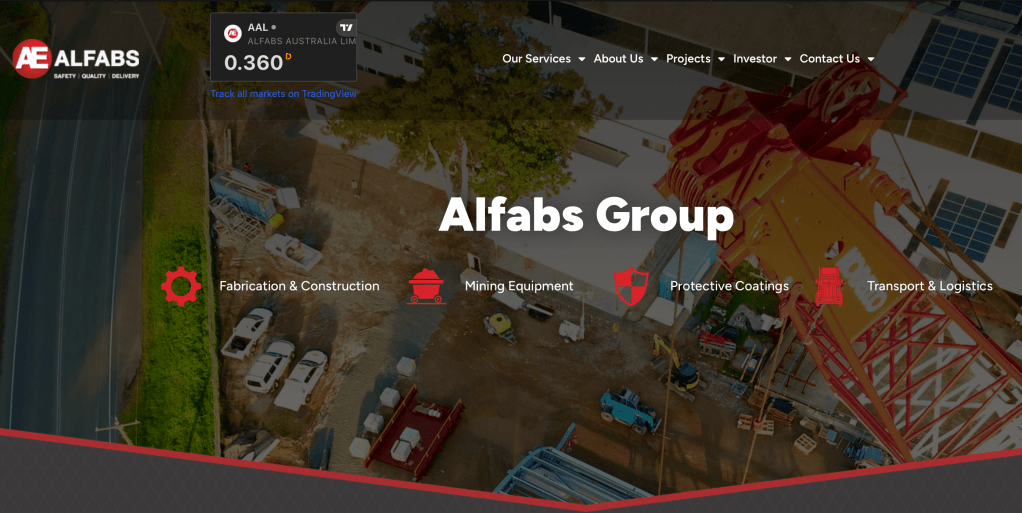
Pro: Alfabs operates in essential sectors such as mining, heavy engineering, and industrial services that underpin much of Australia’s economic infrastructure. For a holding company such as ours, this business could represent a steady, albeit modest, cash flow stream with less volatility than tech or consumer-facing businesses. Its recent IPO and revenue growth reflect operational momentum that could compound over time, fitting a patient capital approach focused on sustainable returns.
Con: Now, there are relatively thin margins, and exposure to commodity cycles introduce real business risk. Mining and infrastructure demand can be lumpy and sensitive to macroeconomic shifts and government spending priorities. It is possible that there could be are struggle against larger competitors with more pricing power and economies of scale.
2. Alignment with Dalmilling’s Focus on Businesses Built to Last
Pro: Dalmilling Capital’s founder (me) values legacy and endurance, and Alfabs’ roots in manufacturing and heavy industrial services reflect old-school industrial strength. (It appears to have family background) and I think the management cares deeply about the people it employees and the company is embedded in regional economies. For that reason, I do not believe it would disappear overnight. There appears to be sound investments in operational efficiency, recent capital raising, and diversified service segments, signals an ambition to scale responsibly. This aligns with Dalmilling’s preference for companies that build foundations for long-term wealth, rather than speculative or trend-driven ventures.
Con: On the flip side, it is a recent ASX entrant with a short public track record (on the ASX). The company’s growth trajectory and capital structure are still being shaped, and it’s too early to say whether it has found a defensible moat or can withstand economic downturns without significant stress. The risk of being a “small fish in a big pond” in the industrial services market could mean it lacks the strategic resilience Dalmilling seeks in its holdings. (I’m sure you chuckled there)
3. Potential for Value Creation Through Operational Improvements
Pro: Dalmilling Capital might see an opportunity to add value by leveraging its experience to improve Alfabs’ governance, cost structure, or strategic partnerships (Yes, with $1000). Given Alfabs’ fragmented business segments; mining, engineering, coatings, transport, there may be room to consolidate operations or refine focus for better margins. Dalmilling’s patient approach could support such restructuring without the pressure for short-term returns, aiming to unlock hidden value over years rather than quarters. (Let’s dream big)
Con: Conversely, the management and operational model appears to be lean and effective, given its recent growth and market entry. Interference from an external investor could disrupt existing dynamics or distract management from executing their strategy. The capital and effort required might not justify the incremental gains, especially if the fundamentals are primarily dictated by external commodity and infrastructure cycles.
4. Exposure to Infrastructure Growth Themes in Australia
Pro: Infrastructure spending and mining investment cycles continue to receive government and private sector support. The service offerings are positioned to benefit as projects ramp up, providing a natural hedge against inflation and a source of growing revenues. Dalmilling’s portfolio, if seeking more industrial exposure, could diversify risks and tap into these cyclical upswings while still favoring quality companies.
Con: As you know, infrastructure cycles are notoriously unpredictable and can be derailed by political changes, funding shifts, or global economic shocks and the dependence on these cycles adds cyclical risk to Dalmilling’s portfolio, which may already have exposures in related sectors. There relatively small size limits its ability to capture a meaningful share of large infrastructure programs, capping growth potential.
Summary
In essence, we are presented with a mixed proposition. Alfabs offers exposure to foundational industrial services with potential for steady cash flows and long-term durability. Yet, its small scale, sector cyclicality, and relatively unproven public track record pose material risks.
The decision hinges on whether Dalmilling prioritises:
Patient capital willing to help build and strengthen a young industrial business,
Or prefers more mature, established companies with clearer competitive moats and stable earnings.
Neither stance is inherently right or wrong; each reflects a different philosophy about what “built to last” means in practice.
If you like this post, comment. Subscribe if you want more of these type of posts.
Welcome to my ridiculous experiment to start with $1000 and try to build a mini Berkshire Hathaway. This might take a thousand years, but ten years from now, I want to look back and say I tried!
What exactly am I trying to achieve?
I am thinking long term. In the year is 2035, can I look back and see whether it was worthwhile? That is the part that fascinates me. As someone who procrastinates, taking this step has taking a lot of convincing in my head. I have decided to name this experiment: Dalmilling. I like the name as it is the name of the street I bought my first property.
By now you probably have figured out I am a Warren Buffet mega fan. That is true and it might annoy you as you read my posts. While this project is in fact a privately held entity, I intent to treat Dalmilling as if it were a publicly traded company.
That means I will be publishing financials, annually letters, reports. Now get ready for some ad nauseam cliche:
Dalmilling isn’t about chasing trends or trying to impress (I simply can’t afford it, when you start with $1k). It’s about thinking long term , just like Warren Buffett did when he took over a struggling textile company and slowly transformed it into Berkshire Hathaway. (Yes, I will cringe about that one day)
My aim is simple:
Invest in businesses I understand
Hold for the long term
Let compounding work quietly in the background
Perhaps I don’t need millions to begin. I hope I remain steadfast and consistent.
$1,000 Is My First Test
Starting with $1,000 allows me to focus. I’ll begin by studying small, businesses listed on the ASX, immerse myself in the reports and aim to understand all I can about the business.
The brokerage platform I have chosen is CMC Markets due to the zero brokerage fees for transactions under $1000.
This capital will be put allocated to a handful of micro-cap stocks that align with the principles I believe in:
Understandable business model
Durable earnings
Conservative financials
Capable, owner-minded management
I will steer clear of ETF’s (this is an experiment after all, let’s have some fun)
Valuation of the company to allocate shares
To keep things structured, Dalmilling is made up of 10,000 shares currently owned by me. At $0.10 per share, the company’s post-money valuation is $1,000.
To be completely honest, I initially wanted to raise $5000, however no one decided to accept the offer. I do not blame them, I am not an investor, nor do I have the training required.
Patience is a virtue?
I’m not in a rush (It is soothing to think that way). Dalmilling isn’t a startup. It’s not a fund. It’s not a product I’m trying to sell.
Another incoming cliche:
It’s a vehicle for disciplined ownership in listed businesses at first, and later in real-world companies that are profitable, simple, and built to last.
This is about slow, honest compounding. Not noise.
So What’s Next?
I’ll begin by investing this initial capital into a few carefully selected ASX-listed businesses that meet Buffett-style criteria. I’ll track every decision. I’ll write letters each year, just like Buffett did, to hold myself accountable and improve my thinking.
I want to start something that my now four year old son will hopefully one day inherit. I am interested to know what you think, leave a comment.
As my mate Buffett would say:
“It is not necessary to do extraordinary things to get extraordinary results.”
And so, Dalmilling begins.
Founder, Dalmilling
16 June 2025 Built with discipline. Compounding with purpose.



 Dalmilling Capital