
My perspectives…
Disclaimer: Nothing I say in this post should be taken as investment or financial advice. I write about companies that interest me and I will occasionally share an opinion.
That should not be taken as me telling you to invest in that company.
Dalmilling Capital is one person with a thousand dollars.
As I was reading my reports, I came across what I thought was an amazing debut to the Australian Stock Exchange for a company.
This company reported the following:
- Net profit after tax $5.7 million up 39%
- Earnings before interest, tax, depreciation & amortisation $12.5 million up 21%
- Maiden fully franked dividend of 1.50 cents per share – payout ratio of 75%
- Earnings per share of 2.00 cents
- Net debt of $11.0 million
To top it off, it appears the management were bullish for FY25.
So thought perhaps I should look at the company and gain a better understanding. Can I understand what they do, and offer myself some competing perspectives, if you will.
Right. This is a long post. If you have made it this far, you might as well indulge me.
1. Long-Term Industrial Exposure and Steady Cash Flows
Pro:
Alfabs operates in essential sectors such as mining, heavy engineering, and industrial services that underpin much of Australia’s economic infrastructure. For a holding company such as ours, this business could represent a steady, albeit modest, cash flow stream with less volatility than tech or consumer-facing businesses. Its recent IPO and revenue growth reflect operational momentum that could compound over time, fitting a patient capital approach focused on sustainable returns.
Con:
Now, there are relatively thin margins, and exposure to commodity cycles introduce real business risk. Mining and infrastructure demand can be lumpy and sensitive to macroeconomic shifts and government spending priorities. It is possible that there could be are struggle against larger competitors with more pricing power and economies of scale.
2. Alignment with Dalmilling’s Focus on Businesses Built to Last
Pro:
Dalmilling Capital’s founder (me) values legacy and endurance, and Alfabs’ roots in manufacturing and heavy industrial services reflect old-school industrial strength. (It appears to have family background) and I think the management cares deeply about the people it employees and the company is embedded in regional economies. For that reason, I do not believe it would disappear overnight. There appears to be sound investments in operational efficiency, recent capital raising, and diversified service segments, signals an ambition to scale responsibly. This aligns with Dalmilling’s preference for companies that build foundations for long-term wealth, rather than speculative or trend-driven ventures.
Con:
On the flip side, it is a recent ASX entrant with a short public track record (on the ASX). The company’s growth trajectory and capital structure are still being shaped, and it’s too early to say whether it has found a defensible moat or can withstand economic downturns without significant stress. The risk of being a “small fish in a big pond” in the industrial services market could mean it lacks the strategic resilience Dalmilling seeks in its holdings. (I’m sure you chuckled there)
3. Potential for Value Creation Through Operational Improvements
Pro:
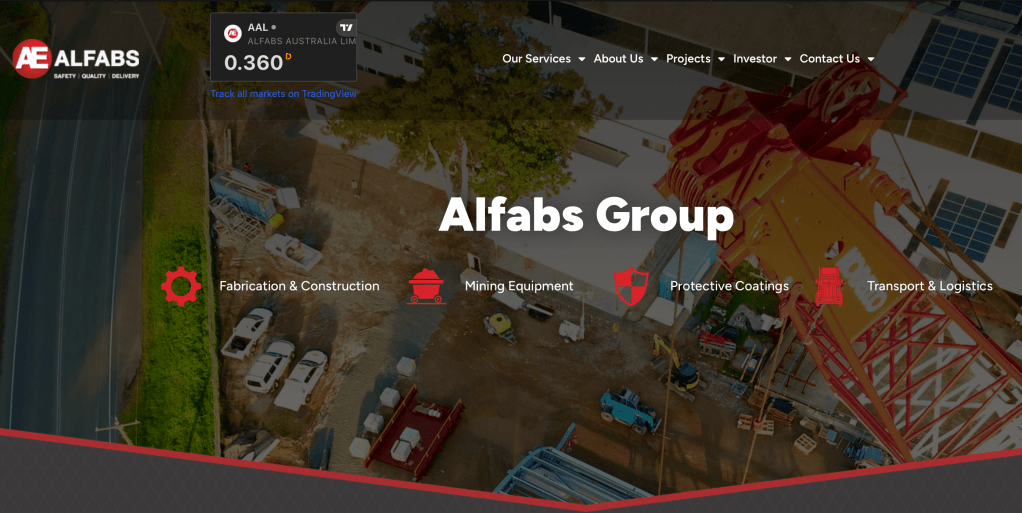
Dalmilling Capital might see an opportunity to add value by leveraging its experience to improve Alfabs’ governance, cost structure, or strategic partnerships (Yes, with $1000). Given Alfabs’ fragmented business segments; mining, engineering, coatings, transport, there may be room to consolidate operations or refine focus for better margins. Dalmilling’s patient approach could support such restructuring without the pressure for short-term returns, aiming to unlock hidden value over years rather than quarters. (Let’s dream big)
Con:
Conversely, the management and operational model appears to be lean and effective, given its recent growth and market entry. Interference from an external investor could disrupt existing dynamics or distract management from executing their strategy. The capital and effort required might not justify the incremental gains, especially if the fundamentals are primarily dictated by external commodity and infrastructure cycles.
4. Exposure to Infrastructure Growth Themes in Australia
Pro:
Infrastructure spending and mining investment cycles continue to receive government and private sector support. The service offerings are positioned to benefit as projects ramp up, providing a natural hedge against inflation and a source of growing revenues. Dalmilling’s portfolio, if seeking more industrial exposure, could diversify risks and tap into these cyclical upswings while still favoring quality companies.
Con:
As you know, infrastructure cycles are notoriously unpredictable and can be derailed by political changes, funding shifts, or global economic shocks and the dependence on these cycles adds cyclical risk to Dalmilling’s portfolio, which may already have exposures in related sectors. There relatively small size limits its ability to capture a meaningful share of large infrastructure programs, capping growth potential.
Summary
In essence, we are presented with a mixed proposition. Alfabs offers exposure to foundational industrial services with potential for steady cash flows and long-term durability. Yet, its small scale, sector cyclicality, and relatively unproven public track record pose material risks.
The decision hinges on whether Dalmilling prioritises:
- Patient capital willing to help build and strengthen a young industrial business,
- Or prefers more mature, established companies with clearer competitive moats and stable earnings.
Neither stance is inherently right or wrong; each reflects a different philosophy about what “built to last” means in practice.
If you like this post, comment. Subscribe if you want more of these type of posts.
 Dalmilling Capital
Leave a comment